At the end of every article on The Guardian‘s website, there’s a small box. Most people scroll right past it.
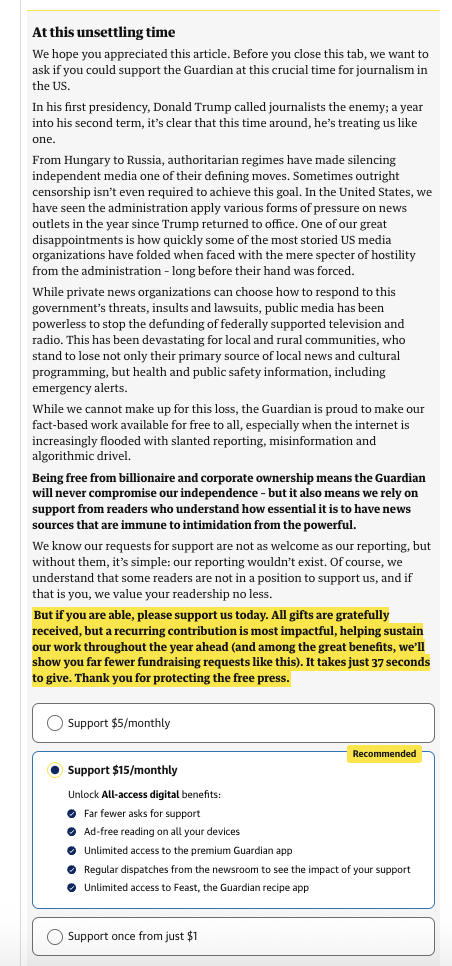
Here’s what it said under a recent article:
“In his first presidency, Donald Trump called journalists the enemy; a year into his second term, it’s clear that this time around, he’s treating us like one.”
I got chills the first time I read it. And then I read it again.
Because what The Guardian has done, quietly, at the bottom of a webpage, is write one of the most powerful cases for support I have ever seen. And if you care about your nonprofit’s ability to raise money in this moment, you need to understand why.
Why now. Why us. Why you.
In my Case for Support class, I talk about the three questions every case must answer. Fundraising consultant Ron Arena calls it the minimalist approach: Why us? Why now? Why you — the donor?
The Guardian answers all three. In plain language. In under 400 words.
Why now? We are living through a defining moment for a free press. From Hungary to Russia,
Click to Download The Guardian Case
authoritarian regimes have made silencing independent media one of their first moves. It’s happening here, too. The current administration has applied pressure on news outlets. Public media has been defunded. Rural communities are losing their only source of local news — and emergency alerts.
This isn’t abstract. People are being left in the dark.
Why us? The Guardian is free from billionaire and corporate ownership. It cannot be bought. It will not fold under pressure, even as some of the most storied news organizations in America have already done exactly that.
Why you? “Without them, it’s simple: our reporting wouldn’t exist.”
That last line is donor-centric fundraising at its finest.
The world has changed. Has your case for support?
Here’s the hard question.
When did you last update your case for support?
As I write in my Case for Support class, your case is the core document that sits at the very center of your fundraising plan. Everything flows from it. Your appeal letters, your grant proposals, your web copy, your emails. If your case is weak, your fundraising will suffer. Every single time.
And right now? A weak case is more dangerous than ever.
We are in a moment unlike any in recent memory. The current administration is targeting nonprofits. Funding streams are being cut. DEI programs are under attack. Immigration services have been gutted. Civil rights organizations are fighting for their survival. And on top of all that, AI is flooding the internet with slanted content and algorithmic drivel — The Guardian’s word, and a good one.
Your donors are drowning in it. They don’t know who to trust or what to believe. They need you to cut through the noise. But you can only do that if your case is sharp.
What makes The Guardian’s case so remarkable?
It leads with urgency — “At this unsettling time” — and never lets up. There’s no throat-clearing, no mission statement boilerplate, no organizational history. It drops you straight into the crisis.
It names the threat directly. No careful nonprofit-speak. The threat has a name, a face, and a documented track record. That specificity is what gives it power.
It weaves story and fact together seamlessly. We see what’s happened in Hungary and Russia. We see rural communities losing their lifeline. We see major news organizations caving at the first sign of pressure. As Tom Ahern writes (and I quote him in my class)
“A great case statement stirs the soul. The hairs on your neck rise.”
This one does.
It is startlingly humble. “We know our requests for support are not as welcome as our reporting.” That single line of honesty builds more trust than a thousand glossy brochures ever could.
And it makes giving feel both urgent and effortless. “It takes just 37 seconds to give.” Friction removed. Door wide open.
Most importantly, it is donor-centric to its core. The donor isn’t being asked to fund a media company. The donor is protecting the free press. Protecting something that belongs to all of us. That is the difference between a transactional ask and a transformational one.
What you need to do right now.
Pull out your case for support and read it out loud. Does it name what is truly at stake? Does it speak to this moment — this urgent, frightening moment — that your donors are living through every single day? Does it answer, clearly and compellingly, why your organization is needed right now more than ever?
In my Case for Support class, I ask students to try an exercise where they imagine their organization disappearing overnight. Poof. Your programs are gone. What will your community miss? Who, if anyone, would take up the slack? Write it down.
Because that is exactly the kind of clarity your donors need from you.
Your donors are scared. They are paying attention. They want to help. But they need you to show them the way. With a case that rises to meet this moment the way The Guardian’s does.











 View Pamela Grow's profile
 I can’t wait to meet with you personally.
Comments on this entry are closed.