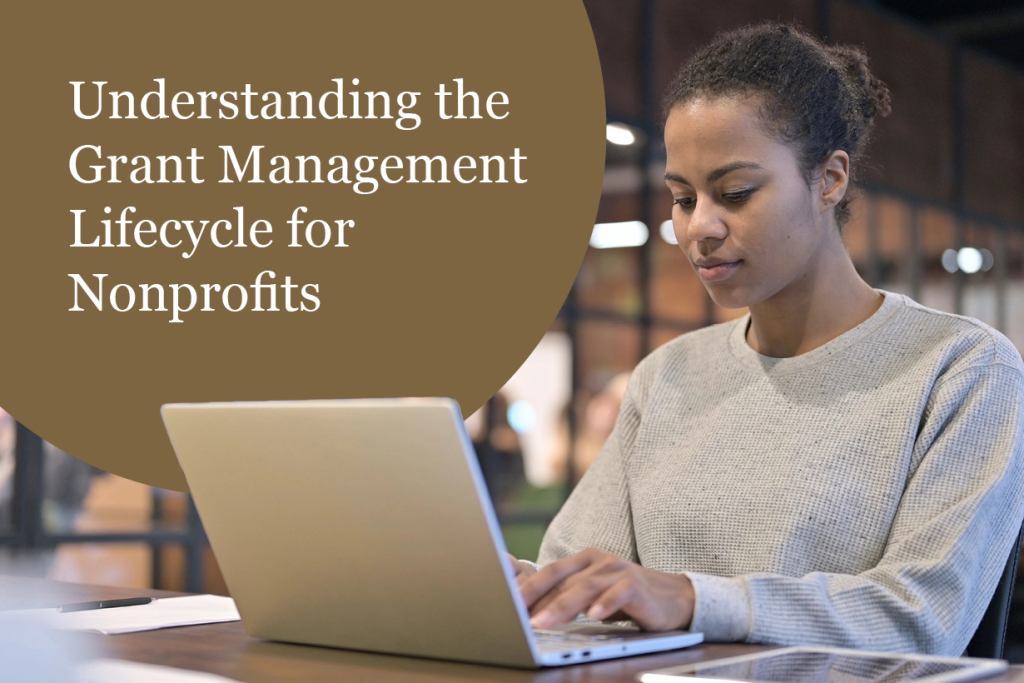
Grants are an effective source of income for many nonprofits. Especially if your organization has previously relied on only one funding stream, like individual donations, diversifying your revenue via grants is likely a sound financial management practice.
The pattern of finding, securing, and using grant funds can be mapped out using the grant management lifecycle. There are typically three phases of nonprofit grant management: before the award, the awarding of funds, and post-award. Within those phases, we’ll discuss five distinct activities your nonprofit will complete, from finding grants to following up after you’ve applied the money towards your mission. Let’s dive in!
Identify Grant Opportunities
When your nonprofit decides to pursue grant funding, a good first step is deciding what you’re pursuing grant funding for and how much funding you’ll need. Being clear from the beginning will help you evaluate grants as you find them.
Thanks to online databases like Candid’s Foundation Directory and GrantStation, you can often find many grants your nonprofit may be eligible for in one place. FreeWill’s guide to finding grants also recommends looking for opportunities on private foundation websites and through corporate giving programs.
Once you’ve identified some potential grants, review the application requirements and eligibility stipulations for each one, and ask yourself the following questions:
- Do the grant and the grantmaker’s goals align with your mission?
- Given the grant’s deadline, do you have enough time to complete the application?
- If the grant is awarded to your nonprofit, how much time and resources will you need to manage it?
- If it’s not a good fit now, could it be a good fit to apply for in the future?
You can also enlist the help of your nonprofit accountant in reviewing potential grants to see which ones could be a good financial fit for your organization.
Apply for Grants
Once you’ve identified a grant you’d like to apply for, one key step is building a relationship with the funder. If you don’t have any connections within the grantmaking organization, is there someone you know who does (such as a board member or volunteer) that you could ask for an introduction from?
Having a conversation with a potential grantmaker will give you a better understanding of what they’re looking for in an application. Plus, a positive, personal relationship is always an asset to a formal application.
When you write a proposal, you should always follow all of the grantmaker’s unique guidelines and requirements. However, most grant proposals will be made up of these elements:
- Abstract: An introduction to the grant proposal and your organization. It can be helpful to write this summary last, once you’ve finalized the rest of your proposal.
- Project Narrative or Statement of Need: In this section, tell the story of why this grant will be impactful for your organization. Make sure to explain the specific need you’d address with the funds.
- Project Description: Outline what your proposed project or program will look like.
- Methodology: Share how you will implement the project or program.
- Evaluation: Identify metrics that will communicate to you and the grantmakers whether your program was successful.
- Budget: Create an anticipated budget for the project to show the funder specifically how the funds will be used.
- Sustainability: Draft a plan for how the project or program will carry on after the grant funds have been exhausted (if applicable).
In addition to the typical grant proposal elements, there may also be supplementary documents required or that can strengthen your case, like past Form 990s or independent audit reports. Providing these financial statements can prove that your nonprofit will use the funds wisely if awarded.
Track Grant Progress
If your grant was successful, you’ll receive an award letter—well done! Now the project or program work begins.
When you reach this phase, you’ll also want to have a clear documentation system in place. There may be intermittent reporting requirements back to the funders during the award period. Identify and mark those deadlines, as well as what information is required, and use that as a starting point to guide your documentation and financial recordkeeping.
Most grant income is restricted, meaning you can only use it for the initiative you specified in your proposal. Jitasa’s guide to restricted funds outlines best practices to ensure your internal systems are up to par for properly managing these funds. For example, you’ll need to note restrictions as you record funding and allocate restricted revenue first when budgeting, so it’s guaranteed to go toward its intended purpose.
Record Grant Funding
On top of properly recognizing grant funding as restricted, grants typically come with additional unique reporting requirements in your financial statements.
The first step is understanding the type of grant, which will be one of the following:
- Unconditional Grant: Funds are issued upfront with no strings attached
- Grant with Contingencies: Funds are issued in installments, once your nonprofit has met the grantmaker’s conditions
- Reimbursable Grant: Funds are reimbursed once you’ve spent money on the project or program
The type of grant and the timing of when your organization receives the funds will impact when you recognize the revenue on your financial statements and forms. Consult with a nonprofit financial professional to ensure you’re complying with financial reporting requirements.
Report Back to the Grantmaker
In the post-award phase, you’ll need to submit all of the documentation you’ve been collecting back to the grantmaking organization. Even if a funder doesn’t require regular reports, communicating the impact the grant money made builds trust and strengthens relationships.
You may have to do this multiple times, so just think of it as keeping lines of communication open between you and the funder, and be prepared with the required information.
As your nonprofit applies for and wins grant funding following the lifecycle stages, the experience will smooth out the process, and you begin it again and again. Your nonprofit can reuse the internal processes and financial systems for grant management and reporting. The beauty of a lifecycle is that you don’t have to reinvent the wheel every time. Good luck in your search and application for grant funding!


 View Pamela Grow's profile
 I can’t wait to meet with you personally.
Comments on this entry are closed.