
Capital campaigns are another one of those development topics that have been jargonized and overcomplicated (like much in our sector) for decades.
When your development systems focus on retention fundraising and stewardship, the next steps — capital campaigns, major donor programs, legacy giving programs — almost flow.
Thanks to Mark Quigley, you now have a step-by-step guide that takes the mystery out of one of the most daunting, and often forgotten, parts of the process: the year before your campaign even begins.
I know, an entire book about what to do before your campaign even starts. Stay with me.
Because this is exactly where most organizations go wrong. They leap before they’re ready. They hire a capital campaign consultant, and then they launch a feasibility study before they’ve done any of the groundwork that would make the study meaningful. And then they wonder why the results come back soft, or why their campaign stalls six months in.
Mark Quigley has seen this play out again and again. And One Year Before Your Capital Campaign: A 12-month pre-campaign guide to success is his answer to it.
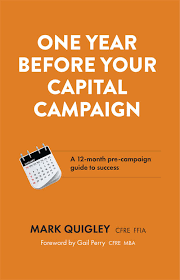 The book breaks down the twelve months before your feasibility study into clear, manageable steps. Mark tells you what’s urgent, and what you can wait on. Most importantly, what absolutely cannot be skipped. That alone makes it worth the price. You’re working with limited time and limited staff, so knowing with certainty what to do first — and why — is everything.
What I love most about this book is that Mark writes the way the best practitioners teach: from real experience. The case studies here are drawn from actual campaigns, actual stumbles, and actual wins. You’ll probably recognize the situations, and, yeah, you might wince a bit.
Mark covers donor relationships, board readiness, organizational storytelling, gift charts, and the kind of quiet, unglamorous work that separates campaigns that soar from campaigns that crawl. It’s not flashy, but it is necessary.
And if you’ve somehow landed here with six weeks before your feasibility study instead of twelve months? He’s thought of that too. There’s an “In Case of Emergency” section that deserves a standing ovation.
This is not a theoretical book.
It’s my favorite kind of book: a working guide.
The kind you keep on your desk, not your shelf, and keep open with a highlighter in hand.
If a capital campaign is anywhere in your organization’s future, even a distant future, this is the book you want to read now.
The organizations that build well before they build big are the ones that actually finish what they start.

 View Pamela Grow's profile
 I can’t wait to meet with you personally.
Comments on this entry are closed.